Showing posts with label High Intermediate (B2). Show all posts

Tuesday, June 2, 2020

Subjuntivo presente con CUANDO- ¿ Qué vas a hacer?

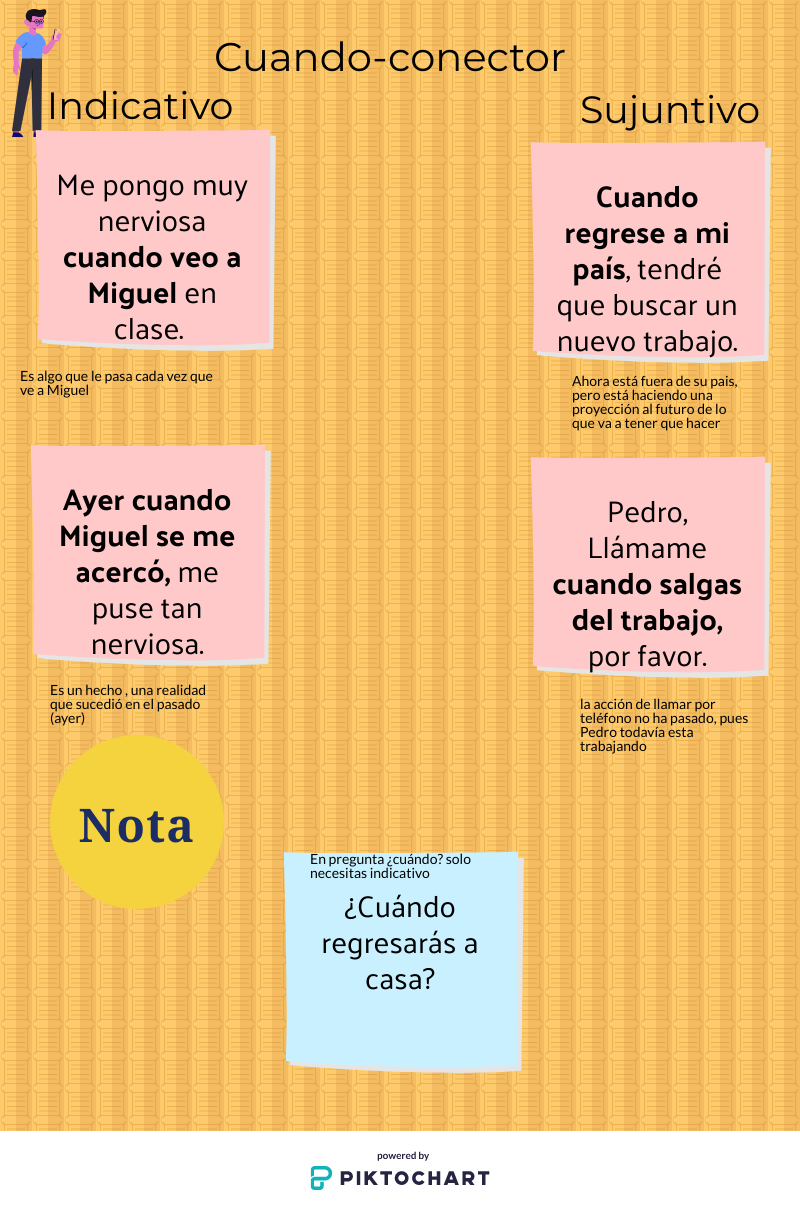
Subjunctive can be a very complicated topic for some students, specially if this verb tense doesn´t exist in the student native language. For instance, it´s very common a student says: "voy a necesitar otro trabajo cuando regresaré a mi pais " or " te voy a llamar cuando salgo del trabajo" but  in both cases there is a mistake , the clause after cuando need to be written in subjunctive not in future or present but why? Let´s study this with a beautiful song from a very famous Hispanic singer called Ricardo Montaner

Playas de Cartagena de Indias. Foto: SSClasespañol

¿ QUE VAS A HACER?. 

¿Qué vas a hacer ahora?
Que el tiempo no nos sobra
¿Qué vas a hacer mañana?
Si ya no hay mañana, si te quedas sola
¿Qué vas a hacer ahora?
Después de abrir la herida
¿Qué va a pasar después?
Cuando se vaya el tren y no haya más salida
Dime ahora ¿pa' qué nos sirve?
Darnos besos invisibles
Un amor es imposible
¿Pa' qué nos sirve, pa' qué nos sirve?
¿Qué vas a hacer...?
Cuando el olvido esté de cumpleaños
Cuando no puedas hacernos más daño

Y nos miremos como dos extraños
¿Qué vas a hacer...?
Cuando mi invierno sea primavera
Cuando me quieras y yo no te quiera
Cuando ni el perro esté esperando afuera
¿Qué vas a hacer?, ¿Prender la luz?
Más humo y más dolor en este cuarto gris
¿Qué vas a hacer?, ¿No fuiste tú?
Más frío y mal humor en esta tarde gris
Click here to watch the video : Ricardo Montaner
The singer is making some questions to his/her lover (maybe they do not love each other so much now). The full questions would be:  
¿Qué vas a hacer cuando el olvido esté de cumpleaños?
¿Qué vas a hacer cuando no puedas hacernos más daño?
¿Qué vas a hacer cuando mi invierno sea primavera?
¿ Qué vas a hacer cuando me quieras y yo no te quiera ?
See, he is asking about moments that have not happened yet. He is visualizing a moment in the future so the clause after cuando, for instances : "cuando me quieras y yo no te quiera ?" Present subjuntive need to be used. In other words, when you use CUANDO  as a conector. You don´t use future tense after it.  
Now answer these questions. Use full sentences: 

  • ¿ Qué vas a hacer cuando termine la cuarentena?
  • ¿ A dónde piensas viajar cuando se normalicen los vuelos?
  • ¿ Qué vas a cocinar cuando llegues a casa?
  • ¿ Qué proyectos ya habrás cumplido cuando tengas 70 años?
Is it clearer now? Do you need more examples? Let me know.

Remember: Read newspapers, magazines in Spanish. Listen music or watch TV in Spanish . You will learn a more realistic Spanish. 

#subjuntive #subjuntivopresente #subjuntivoespañol #spanishlanguage #learnspanish

NOTE: English is not my native language, please if you find any mistake, please let me know and I will correct it. Thanks..
SSClasespañol by Sirle Sarabia is licensed under CC BY-NC 4.0CC iconby iconnc icon

Saturday, May 2, 2020

Verbo Estar- No estás solo.

Verbs Ser and Estar are very confusing for many foreigner students. In many other languages there is not a real different between ser and estar.  For instance ,  In English is just to be , in Dutch  verb zijn, in German is the verb  sein but in Spanish they are  two different  verbs. Many Spanish students struggle trying to understand the rules, specially that one which says that ser is for permanent characteristics and estar is used to talk about temporal characteristic. But have you, Spanish learner students, thought that everything is clearer if you study it in a real context? Yes, rules are importants but they are not the only way to learn a language. You need to get an approach to the language in a real setting. That is the reason in this post I would like to share with you this lyric ( at the bottom you will find a link to watch the video). This lyric belongs to a song called " No estás solo"( you are not alone). The latin singers, Carlos Vives and Ruben Blades dedicated this song to all those people who are sick with Covid-19 (be sick- estar enfermo) 
Capurganá.Foto : SSClasespañol


No estás solo - Canción de Carlos Vives y Ruben Blades


Hay vainas* que se aparecen cuando uno menos las piensa
Llegan y aunque no las quieran se quedan por unos día'
Nos dicen que estás enfermo y venidos para animarte. Un malestar no es eterno, y menos si se comparte
Y aunque interminable parezca la noche
Al final se irá con la luz del día
No pierdas la fe
Siempre ten presente
No estás solo, esa vaina se quita
No estás sola, ten paciencia y verás
No estás solo, y aunque eso mortifica
No estás solo, te vamos a cuidar
No estás solo, aquí están tus amigos
No estás sola, tu familia aquí está
No estás solo, y aunque eso mortifica
No estás solo, te vamos a cuidar

Pay attention: Ser una persona solitaria Vs Estar solo. When you want to express a person for some reason (maybe is introvert, don´t like to be surranded by people or has a problem with socializing) doesn´t like to have company or doesn´t enjoy company,  we say in Spanish: " él / ella es una persona solitaria ". Pay attention to the way to built the sentence : Ser+ artículo (una) + noun (persona) + adjetive (solitario/a) .
But when you say in Spanish: " Luis está solo" could mean two things: 1) Luis is alone in a literally way :  Luis is alone, There is noone else around him  or in his life . Or a more methaphoric meaning, Luis feels lonely.
See what I mean? it is not only about permanent o temporaly, you , as a speaker, need to have clear the situation and what you really want to express.
I hope you have enjoyed this post. I read your comments. 
Vocabulary: Vaina*: it is  a very coloquial expression using in  multiple ways. it is used to replace a thing or situation that is already known by the speaker. In this song is used to refer to the sick person´s problem. The sickness he/she  is dealing with. 


Remember : Read newspapers, magazines in Spanish. Listen music or watch TV in Spanish . You will learn  a more realistic Spanish. 

NOTE: English is not my native language, please if you find any mistake, please let me know and I will correct it. Thanks. 

SSClasespañol by Sirle Sarabia is licensed under CC BY-NC 4.0CC iconby iconnc icon

El imperativo : formas usted y ustedes

Laguna de Iguaque. Foto:SSClasespañol


Some foreigner students connect the imperative only for commands or orders and they think if they talk in Spanish using  imperative, they are being rude. But not at all. In Spanish the imperative is used beyond the commands or orders. I dare to say closer the relationship is the imperative is more common to use among the speakers.
Let´s watch the video and pay attention  how this cute lady explains us some instructions to be safe during the Covid-19 crisis.


As you could notice , here the most important use of imperative is to give some instructions but at the same time, this lady gives us some advices about how to keep elderly people save during the crisis, then the imperative is used for :
1. Instructions
2. Recommendations
3. Offering something (this use is not on the video) 
Let´s look at some examples from the video: 

  • Mantengan la distancia
  • Muestren la berraca* información 
  • Hablen con nosotros

The three verbs above , they all are conjugated in the form USTEDES. Forming usted o ustedes in imperative is not that complicated. You need to do this:
Hablar→presente → usted habla→imperativo → hable

Hablar→presente → ustedes hablan→imperativo → hablen

You just change  the ending vowel in present simple. If the verb finishes in _AR , in present simple the vowel is  A, in imperative changes to E       - A→E

 If the verb finishes in _ER/_IR , in present simple the vowel is  E, in imperative changes to A       - A→E

This rule applies even when the verb is irregular.

Mover →presente → usted mueve→imperativo → mueva

Mover→presente → ustedes mueven→imperativo → muevan

BUT
If the verb has an irregular YO (first singular person ) , the irregular root is kept in the imperative conjugation. LOOK:

Mantener→presente → yo mantengo→imperativo → mantenga

Mantener→presente → yo mantengo→imperativo → mantengan

When you need to say a negative instruction or recommendation. The rule above explain also apply 
( only if you are talking using USTED OR USTEDES- with the conjugation Tú is different)  

No visiten a los abuelos

IMPERATIVE WITH PRONOUNS

What happens when you need to include a reflexive pronouns or direct/indirect object pronouns?
Some examples are provided in the video too:

Affirmative:

Cuídenlos ( a los abuelos) - pronoun after the verb in imperative and it is only one word

Negative 
No nos dejen arrumados-  pronoun between NO and the imperative verb.

Is it clearer now? Remember that also you will need to gather more vocabulary and verbs conected to the instruction you would like to say, that is the reason I suggest to read , watch and listen real material, they will give you examples how we really speak. 

*Berraco/a: in Colombia means "difícil de resolver, valiente or bravo". Although in the video is more used to express: " tell the entire truth , it doesn´t matter how hard or cruel is"

 + English is not my mother tongue, Please if there is a mistake , let me know and I will correct it. 

SSClasespañol by Sirle Sarabia is licensed under CC BY-NC 4.0CC iconby iconnc icon